A 95% detector can still be wrong most of the time.
A worked example of base rates, false positives and what those numbers mean when an alert affects real people.
Read the investigation ↗
Research, original arguments, institutional memory and applications. Different editorial forms for different kinds of stories, with traceable sources and real examples.
The best research begins with a question that matters. These three posts look at what popular arguments, simple models and actual resources can tell us.
A worked example of base rates, false positives and what those numbers mean when an alert affects real people.
Read the investigation ↗Freight, condition, resale rates and labor matter more than the advertised comparison price.
Read the market analysis ↗These protocols can connect the same organizations, but they do not carry the same identity, records or authority.
Read the comparison ↗A viral accounting claim, public meeting records, wholesale inventory, a creator's archive and the rise of coding agents. Follow the original sources into the applications we're building.
Read the illustrated issue
Read through the questions linking AI authority, living websites, accessible software and the people maintaining internet culture. Each path has original research and public application examples.
Authority, evidence and the right to question the goal itself.
Follow the evidence series ↗What tools and living presences could make possible for small communities and businesses.
Explore profiles and creation ↗Independent media, lost archives, creator rights and the economics of keeping the record.
Meet the internet operators ↗Authority, living profiles, expressive tools, and the people who keep culture alive.
Filter by topic or search for a specific source, argument or mathematical idea. The articles link their original sources and related work.
Sources, dependencies, build environments, artifacts, deployment and readback are separate identity and verification problems.
Tokenization, language, normalization, ranking and access rights make search a contextual operation rather than a string match.
A measured level and a difference in temperature are different quantities even when the units look familiar.
Transit service days, operational time, passenger time and clocks require more than calendar dates.
CSV serialization, spreadsheets, field types and downstream execution reveal why a simple export is a trust boundary.
Compositions, recordings, tracks, releases, performers and rights need a relational model, not one media row.
Caching makes a promise about reuse, not truth; freshness, invalidation, variation and privacy need explicit policy.
Captions, transcripts, descriptions, chapters and translations serve different people and cannot be generated interchangeably.
Money amounts are incomplete without units, quantity, terms, timing, taxes, availability and authority to sell.
Coordinates depend on reference systems, transformations, accuracy and a definition of what feature is being measured.
Telephone numbering is a routing system, not a durable human identity or a permanent authorization to act.
A listing's discoverability, vacancy, employment terms and authority to recruit are different states.
Names change across context and time; an identity system should preserve people without declaring one spelling their essence.
Currency display, a quoted rate, a conversion obligation and a settled transfer have different dates and counterparties.
An address's grammar, a server's capabilities, a mailbox's existence and a person's consent are four different questions.
Persistent identifiers can preserve reference relationships without guaranteeing that every version, claim or accessible copy remains unchanged.
Unicode graphemes, code points, bytes, scripts and fonts expose different meanings of a single word: character.
Civil time is a political rule, an instant is a measurement, and a recurring appointment needs both.
URLs, domains, ownership, redirects and long-lived identities do not change together—and durable publishing needs succession plans.
Pagination is a consistency decision about evolving records, not simply an offset and a limit.
A GTIN identifies a trade item, but stock, packaging, batches, reservations and rights to sell live elsewhere.
CVE identification, technical severity, exploit conditions and business exposure must not collapse into one red badge.
Postal delivery, legal residence, property, geography and care services need different representations of the same location.
Legal entities, brands, subsidiaries, trading names and changing ownership cannot be merged by a string match.
A response to the viral November 2026 accounting-software replacement anecdote.
A worked economy-of-scope example for shared software, teams and customer operations.
Documents become databases, social networks become shops and games become economies. But bigger apps are not the only answer.
The people running local newsrooms, forums, radio archives and creator communities are operators, even when nobody calls them that.
Small teams need many of the capabilities of large organizations but rarely have the same budgets or implementation staff.
Visual storytelling explains complex ideas. Living publications could also help readers contribute, collaborate and act.
Independent review is a social condition as much as a software feature: someone must be able to say the plan is wrong.
Model Hardware Standard, scientific equipment and the difference between proposing an experiment and operating a device.
As code gets cheaper to produce, maintenance, trust, distribution and coordination may matter more.
What looks like a shortage of originality may also reflect the price, complexity and isolation of the tools people need to participate.
Why dependent evidence fools simple Bayesian confidence scoring.
Excel showed that accessible modeling could become serious business software without a software team.
A living public presence can hold publications, collections, projects and relationships for people, organizations and places.
How task selection and changing agent workflows complicate developer-productivity estimates.
Milgram's obedience experiments illuminate a modern failure: people and systems can correctly perform a task whose purpose is wrong.
The missing internet includes recordings, documents, memories and collections kept alive by people and institutions with little digital infrastructure.
When a plausible idea can be turned into software immediately, we need to distinguish usefulness from merely successful implementation.
What happens to forums, publications, recordings and communities when the people running them retire, die or disappear?
Clippers, broadcasters and editors are increasingly important distributors. The context and rights surrounding a clip matter as much as its reach.
A simple expected-cost model for selecting models, agents and native execution backends.
Making work discoverable does not grant the host, archive or AI provider the right to reuse it without limits.
A website can be the front door to a living publication, business or community without containing the whole institution.
Jon Yongfook's service-first startup argument and the economic case for shared infrastructure.
The promise and limits of Prithvi-EO and remote sensing for regional operational intelligence.
What feeds contribute to temporal research alongside archives, video and structured data.
What NIST federation guidance teaches about account boundaries and separate relying parties.
Why local geography, images, text, time and operational actions need different measures of similarity.
An explosion of new makers is not automatically a decline in culture. Tools can also make participation possible for people previously shut out.
What accessible creative primitives and communities can teach us about making serious software available to everyone.
Why an interoperability strategy needs to preserve the meaning of each protocol.
The original vibe-coding post has a boundary that its most enthusiastic interpretations forget.
Shopify's influential AI memo is a strong case for learning, but adoption should not be confused with outcome.
Why CGC, PMG and NGC records matter beyond the object's resale price.
What epsilon protects and what still needs source identity, consent and access rules.
x402, automatic API payments and the missing institutional decision before settlement.
Bidirectional charging connects vehicles, buildings, utility programs and operating schedules.
What WorkOS auth.md contributes to machine registration, and why the destination still matters.
Taking Jason Lemkin's weakening-moats argument seriously without jumping to the death of B2B software.
DuckDB-Wasm, local files and the limits of moving analysis closer to the user.
Creators, curators, archivists and community operators need collective bargaining power, not simply better individual dashboards.
Unicode, line endings, schema changes and the mathematical meaning of identity continuity.
Why licence rights matter when evaluating external software as productive capital.
Real estate data standards, source rights and the product opportunity beyond copying listings.
As the internet expands, what gets archived, indexed and translated is shaped by attention, money and institutional capacity.
What Boris Cherny's extraordinary Claude Code output measures, and what it leaves unanswered.
Antithesis and SQLancer offer different ways to challenge software beyond happy-path tests.
Why the creator economy needs publishing, source management, relationships and commerce tools.
Task-conditioned rate–distortion explains why elegant memory summaries can fail at execution.
The base-rate calculation that belongs in civic surveillance and anomaly-detection discussions.
Expected resale value, missing inventory, freight and returns matter more than headline discounts.
The useful idea behind DocTypes, and why native application composition needs more than importing tables.
Parallel implementation is valuable when each worker has an independent role and a known source revision.
A note from the early FPQ and Qwen experiments about model loading, prepared state and actual generation speed.
What the earliest Whisper and FFmpeg experiments taught us about complete creator workspaces.
What a shared platform should change for an agency managing several independent customers.
What four public domains and GitHub Pages taught us about deployment destinations and browser readback.
What software delivery still needs after agents can write a feature in minutes.
Why external service installs, credentials and authorized actions belong to separate systems.
Why Aurekai treats software, engineering and operating knowledge as assets shared across businesses.
Why old WordPress, PHP and hosting migrations are opportunities to improve operations while keeping history intact.
How profiles, authors, reading rooms, channels and collections can be connected without swallowing the original publication.
Why polished frontend compositions need the right account records and workflows behind them.
Connecting supplier identities, options, procurement, shopping and spatial planning.
Sourcing, wholesale inventory, spare compute and existing services through the same operating lens.
How one source can support discovery, company profiles, CRM and narration without becoming four unrelated copies.
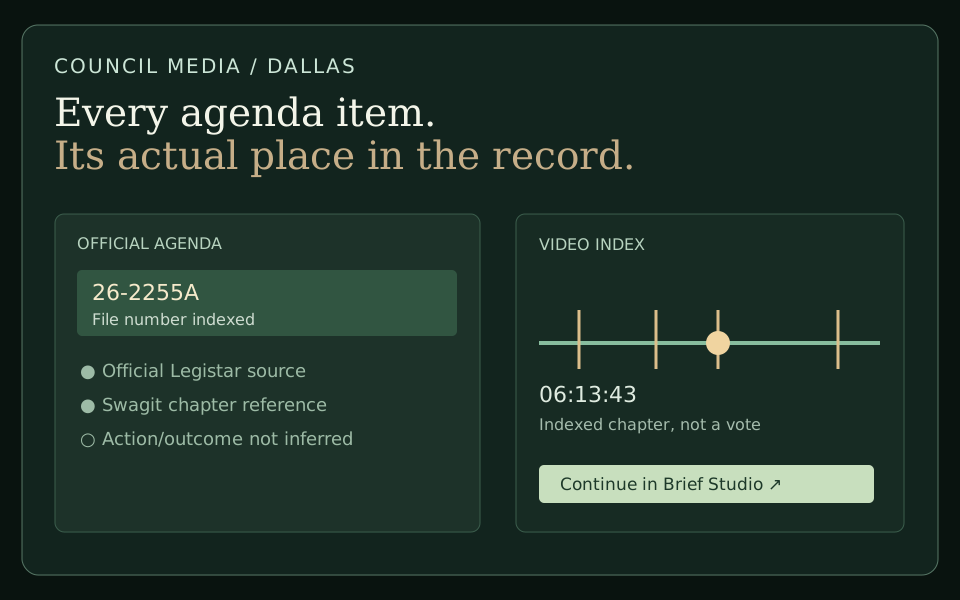
Connecting public meeting records, earlier decisions and recordings into useful civic research.
No articles match that search. Try another topic.
The articles have stable URLs and editable Markdown behind them. For now they're public pages with stable links and independently editable source documents. Additional publishing integrations can be added without changing those URLs.