“Are found in Heaven by the newly dead / Stored in its strongholds through the years.”
Imagine a specialist discussion forum that began in 2003. Its founder pays the hosting bills, moderates disputes, renews the domain and knows where every important conversation lives. A generation of mechanics, musicians or amateur historians has written explanations that cannot easily be found elsewhere. One morning the founder is no longer able to operate it.
The forum has not necessarily become irrelevant. But its infrastructure may be held together by one person's credit card, passwords and personal knowledge. What survives if the owner retires, becomes ill or dies?
An account is not an institution §
Platforms make account creation simple and succession complicated. An organization may depend on an administrator who happens to own the login. A recording archive may depend on a volunteer who knows its format and history. The social value of such a place can exceed any commercial value assigned to its domain or files.
The first mistake is to treat the entire problem as a password-recovery exercise. Restoring access to a server does not resolve who owns a photograph, who may publish private correspondence, what former moderators agreed to, or whether a family may authorize the synthetic recreation of a deceased person's voice.
There are at least four distinct questions. Custody: who has the material or equipment? Rights: who may reproduce or license a work? Representation: who may speak on behalf of a person or institution? Stewardship: who has accepted the responsibility to maintain it? The answers may point to different people.
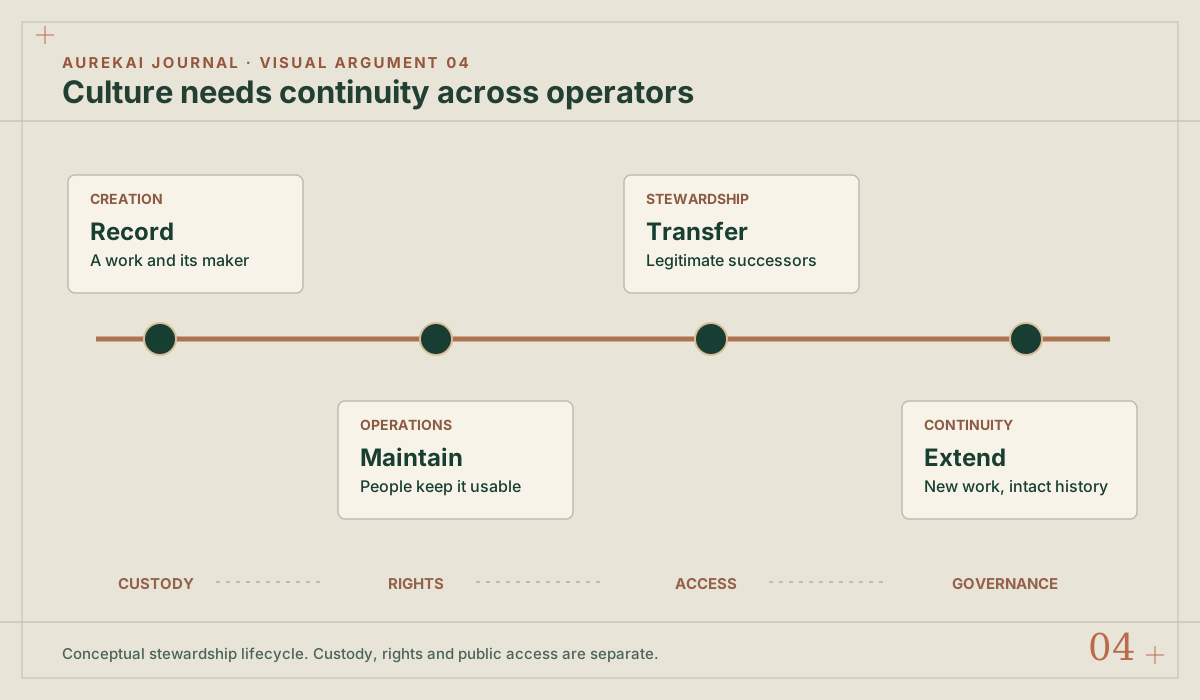
- What happensA founder leaves an institution
- What it missesLogins, rights, and memory have no successor
- What could changePlan stewardship before the emergency
Death does not turn culture into free inventory §
In the United States, copyright on most individually authored works created after 1977 generally lasts for the author's life plus 70 years, with substantial exceptions and different rules for older and work-made-for-hire material. The U.S. Copyright Office explains these categories[1]. Owning a physical tape or hard drive does not by itself confer copyright, and inherited control of an account is not automatically permission to redistribute private messages.
Nor does technical preservation require unlimited public access. A community can preserve a description of a restricted collection, document where material is held, or arrange lawful access for certain researchers. Consent, privacy and the interests of living participants may make some records inappropriate for public release.
These differences become important when AI offers to reconstruct a person's voice, write in their style, or continue publishing under their name. An archive of a life does not create new consent from the person who lived it. A tribute can remain clearly a tribute rather than presenting a synthetic continuation as authentic.
Build for continuity before the emergency §
A more durable institution could appoint successors, document operational responsibilities, separate personal and community assets, and retain stable records of authorship, licenses and restrictions. A small nonprofit, cooperative, library or trusted group might carry a publication forward when a founder leaves. An independent publisher might prearrange where archives will go if the site shuts down.
This does not require the same legal structure everywhere. It requires making succession an ordinary design question rather than something addressed only after a domain expires.
For an independent operator, continuity infrastructure might be as mundane as an export, a documented rights inventory, a durable source identifier and a named custodian. But taken together, those building blocks let the digital work of a community outlast the particular technology—and sometimes the people—that first gave it a home.
Memory should remain a relationship §
The aim is not to prevent change. A living community should be able to grow beyond its founder, correct the founder's account of events and develop new practices. Historic material can remain attributable to its original contributors while new participants make their own work around it.
The internet has no shortage of tools for starting things. It needs better ways to carry forward the institutions that have already become important to somebody.
Read next: Who keeps the internet alive? and The archive is not the owner.
Sources and further reading
References point to original material linked in the essay, not independently invented citations.
- U.S. Copyright Office explains these categoriescopyright.gov↩
Related reading
More articles that explore this subject from another angle.
Succession requires moving business records and knowledge, not just changing hosting.
Follow this connection ↗Continuing identityThe profile is bigger than the personAn enduring public presence must not imply a deceased creator can grant new consent.
Follow this connection ↗Another essay leads hereA library of Alexandria selected by demandAs the internet expands, what gets archived, indexed and translated is shaped by attention, money and institutional capacity.
Read the earlier argument ↗Another essay leads hereThe address in the browser is not the institutionURLs, domains, ownership, redirects and long-lived identities do not change together—and durable publishing needs succession plans.
Read the earlier argument ↗