“There is no Frigate like a Book.”
Some of the web's best experiences are still stories. They combine original reporting with visual pacing, evidence and a point of view. Their interactions aren't arbitrary controls; they let people understand something that would be harder to communicate in ordinary paragraphs.
That lesson matters for Aurekai. A beautiful research story is useful in its own right. We should not ruin it by turning the page into a dashboard.
Interaction should do editorial work §
The Pudding's 2025 visual-storytelling awards[1] singled out Dithering — Part I for using visual explanation to make a technical idea understandable. The motion serves the argument.
Noomo's Vogue Business and Archrival case study[2] describes a designed research experience with distinct visual pacing and moments meant to be shareable outside the article. The implication is useful: a section might reach someone in a social feed long before they encounter the complete work.
Webflow's scrollytelling guide[3] also illustrates why an immersive path need not be the only path. A conventional browsing layout should remain available to visitors who want it.
- What happensA reader reaches the final paragraph
- What it missesThe story has no meaningful continuation
- What could changeOffer optional, authorized participation
What happens after someone understands? §
Imagine a visual report about a proposed city infrastructure project. It explains the background, timeline, budget and competing perspectives. The reader can explore documents and see what changed across versions. Factual claims point to sources; commentary is attributed; uncertainty remains visible.
One reader saves the documents to a collection. Another follows the upcoming council meeting. A local researcher contributes a correction. A neighborhood organization assembles a public-comment packet from already-public material. A contractor may encounter a separately authorized opportunity.
These continuations should be optional. The reader should be able to finish the article, understand the subject and leave. Not every story should be a sales funnel or require an account.
One source, many appropriate uses §
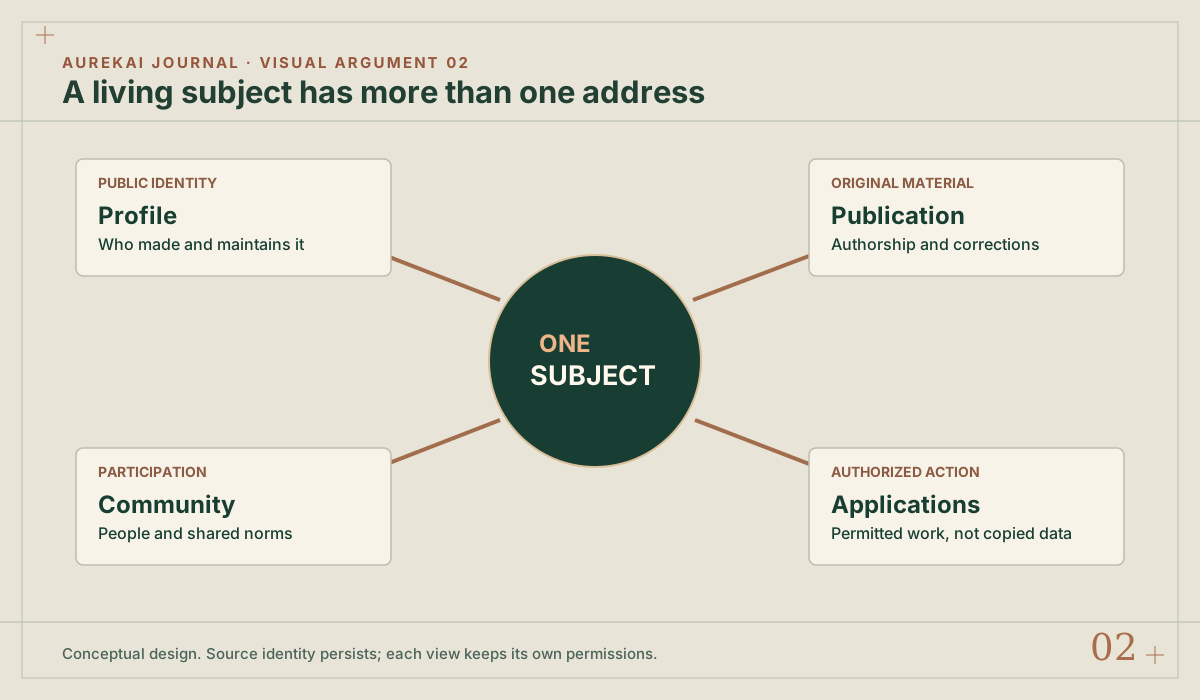
A report can appear in a public essay, a source library, a timeline, a discussion and a collaborative project without losing identity. But a public record is not a private working note. An archived official statement is not a live instruction. An AI-generated summary should never quietly replace the underlying source.
Moderation, privacy, attribution and review make participation sustainable. In a civic setting, sensitive personal details may need redaction. Contributions should not be presented as verified facts merely because they were submitted.
Bonfÿre's retained sources, permissions and account-owned continuations could support this distinction beneath Aurekai's publishing surfaces. The reader sees a coherent experience; the underlying work maintains separate authority.
The ambition is not to put controls on every article. It is to create publications that can continue into useful collaboration when the reader wants them to.
Read next: The profile is bigger than the person and A council agenda can be useful.
Sources and further reading
References point to original material linked in the essay, not independently invented citations.
- The Pudding's 2025 visual-storytelling awardspudding.cool↩
- Noomo's Vogue Business and Archrival case studynoomoagency.com↩
- Webflow's scrollytelling guidewebflow.com↩
Related reading
More articles that explore this subject from another angle.
One retained source can support different account-owned continuations without becoming several invented facts.
Follow this connection ↗The responsibilityThe archive is not the ownerParticipation does not erase the original publisher's rights or provenance.
Follow this connection ↗Another essay leads hereA public page should open the real applicationWhy polished frontend compositions need the right account records and workflows behind them.
Read the earlier argument ↗