“Any fact becomes important when it's connected to another.”
A project meeting can be full of capable people and have almost no real disagreement. Everyone knows their assignment. Everyone reports progress. Each review checks whether the deliverable meets its stated requirements. The room sounds healthy, but one uncomfortable question never gets asked: why are we doing this?
Adding an AI reviewer to that room doesn't automatically change the dynamic. If the reviewer is rewarded for finding bugs in the agreed plan rather than questioning its premises, it may simply make the wrong plan harder to criticize.
Agreement is not independent judgment §
In her 1999 study of 51 work teams[1], Amy Edmondson described psychological safety as a shared belief that interpersonal risk taking is safe. The research found an association between psychological safety and learning behavior, with learning behavior mediating the relationship with performance. That is a narrower, more meaningful result than saying teams should always agree or that being nice leads to better outcomes.
People have to be able to report uncertainty, identify errors and challenge assumptions without treating each challenge as a personal betrayal.
In software development, a peer reviewer may inspect a patch carefully but not know why the product change was commissioned. A test runner can prove that a permission check works while being unable to decide whether the application should collect the personal data in the first place. An organization can therefore achieve excellent local verification and poor global judgment.
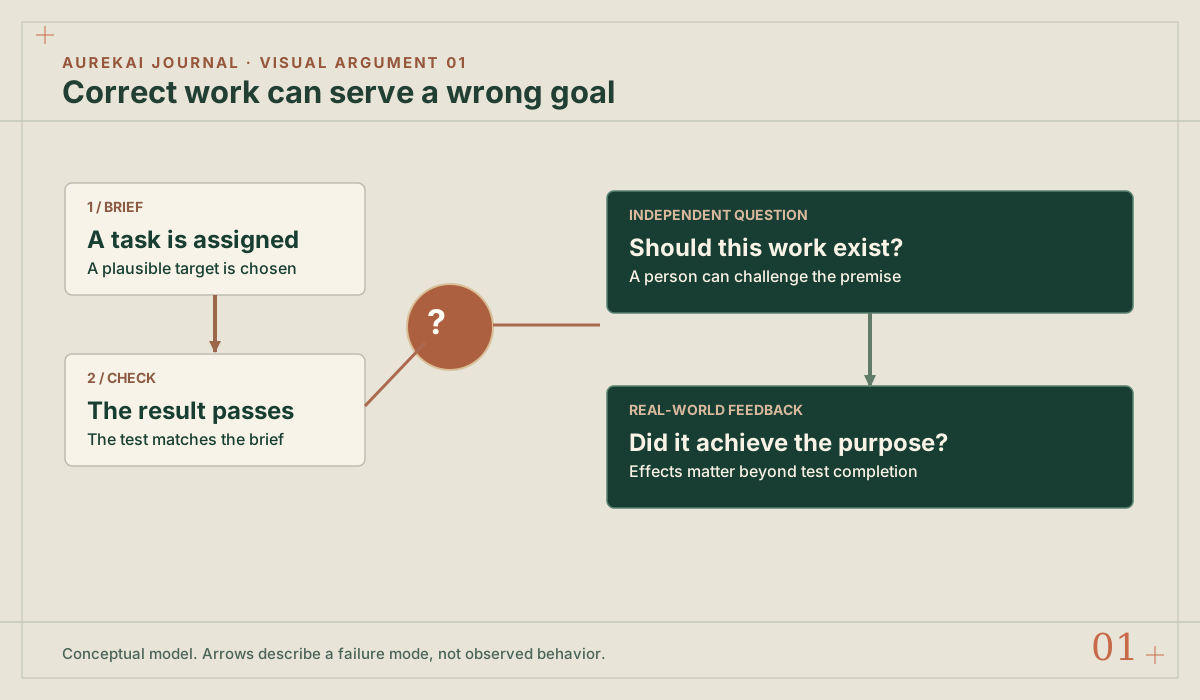
- What happensEveryone reports progress
- What it missesThe same premise guides every reviewer
- What could changeProtect evidence-backed disagreement
Two different kinds of independent review §
The first kind checks whether a claim is supported: does the evidence match the code, test result, publication, financial record or source document? It needs reproducibility, provenance, traceable inputs and clear limits.
The second kind checks the legitimacy and value of the objective: whose interests are served, who is affected, what alternatives exist and what would change our minds? It needs domain expertise, multiple perspectives and the authority to say no.
The NIST AI RMF's measurement guidance[2] recognizes the importance of separate evaluation teams and feedback from affected stakeholders. That is a useful way to understand verification as a social process, not just a second model call.
Dissent must have somewhere to go §
A person can identify a problem yet still lack a route to escalate it. A model can flag a limitation that disappears from the polished final summary. A source can contradict the project's premise while remaining buried in an attachment.
A richer system could retain disputed assumptions alongside accepted facts, make review responsibilities visible, and keep decisions tied to the evidence and people authorized to make them. An unresolved challenge would not need to stop every harmless exploratory task, but consequential actions should not silently bulldoze it.
Aurekai's account-owned review and evidence infrastructure is relevant insofar as it helps preserve that context. The technology should make it easier to disagree constructively, not create an automatic veto machine or pretend that the existence of a review receipt equals thoughtful review.
Sometimes the most valuable contribution in a capable team is not producing a better answer. It's noticing that everybody is answering the wrong question.
Read The machine told me so for the authority problem behind this one.
Sources and further reading
References point to original material linked in the essay, not independently invented citations.
- 1999 study of 51 work teamsjournals.sagepub.com↩
- NIST AI RMF's measurement guidanceairc.nist.gov↩
Related reading
More articles that explore this subject from another angle.
A measured counterfactual can complicate a story repeated by an entire team.
Follow this connection ↗Testing the real systemA green screenshot can't tell you whether a database lost a writePassing visual checks is not equivalent to proving behavior and effects.
Follow this connection ↗Another essay leads hereWhat happens when two coding agents disagree?Parallel implementation is valuable when each worker has an independent role and a known source revision.
Read the earlier argument ↗