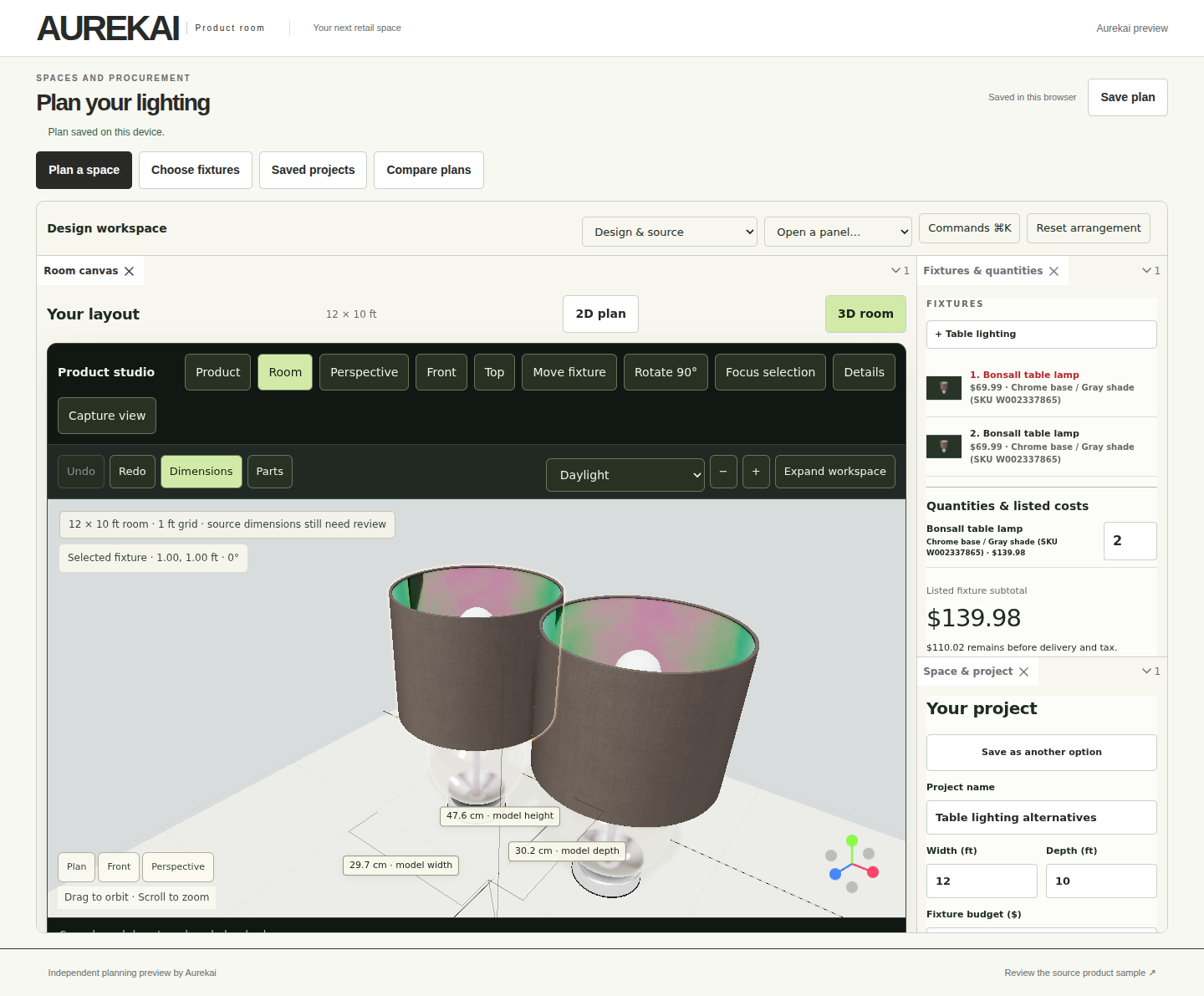
Imagine picking a chair from a shop catalogue, dragging it into a room planner and then sending the selection to a buyer. If the colour, size, supplier and price disappear along the way, the experience looked clever but didn't help anyone buy the chair.
This came up repeatedly as we built spatial product experiences for Aurekai. A beautiful 3D interface is one part of a useful product. Another part is keeping the object connected to the commercial and operational records that give it meaning.
A product has several useful views §
A supplier knows its part number, options, dimensions and availability. A shopper cares about how it looks, what it costs and whether it fits. A procurement team may need lead time, quantity, shipping, substitutions and approval. The room planner needs geometry and scale.
These are views over the same underlying thing. GS1 Digital Link[1] is a useful external reference: it links a product identifier to different types of online information. Our Matrix and catalogue work approaches a broader version of that idea for products used across applications.
The design has to survive the handoff §
The room planner should preserve the exact product choice, configured options and quantity. If a shopper chooses a specific fabric or finish, the procurement workspace shouldn't receive a generic 'chair' without those details. Where price is an observation rather than a firm offer, the application should make that clear.
The same approach applies to equipment lots, wholesale stock, secondhand goods or construction materials. A useful product identity allows items to move between discovery, research, planning, purchasing and fulfillment.
You can see this thinking in the product room and catalogue workspace. They're entry points into a larger set of native catalogue, sourcing and account applications.
The real opportunity is to make a product record valuable long after someone closes the picture of the room.
Sources and further reading
References point to original material linked in the essay, not independently invented citations.
- GS1 Digital Linksupport.gs1.org↩
Related reading
More articles that explore this subject from another angle.
Excel showed that accessible modeling could become serious business software without a software team.
Read the earlier argument ↗Another essay leads hereA $10,000 wholesale lot priced at $2,000 may still be a bad dealExpected resale value, missing inventory, freight and returns matter more than headline discounts.
Read the earlier argument ↗Another essay leads hereOne product code cannot tell you what is on the shelfA GTIN identifies a trade item, but stock, packaging, batches, reservations and rights to sell live elsewhere.
Read the earlier argument ↗