

“I always thought of paradise as being a library.”
We are building extraordinary ways to search and summarize human knowledge. At the same time, the records from which that knowledge can be retrieved are incomplete. Some are preserved in great detail; others disappear without ever being indexed.
There is a Library of Alexandria quality to the present moment: the possibility of broad cultural access sits alongside the danger that whole categories of material will become effectively invisible.
But the archive is not assembled evenly. Attention, language, institutional funding, legal restrictions and commercial value help determine which records survive.
Searchability is not the same as preservation §
The UNESCO Charter on the Preservation of Digital Heritage[1], adopted in 2003, warned about obsolescence, inadequate maintenance and the loss of born-digital cultural material. The warning predates today's generative AI boom by two decades.
A modern search system may be capable of answering a remarkably complicated question about material that has been digitized, described and legally made available. It cannot recover an interview that was never recorded, a forum that vanished before crawling, or a community's historical context that no source retained.
The Internet Archive's Wayback Machine help guide[2] explains that captures are uneven; submitting one public page does not automatically preserve an entire site or schedule future captures. A missing capture is not proof that a page never existed.
- What happensPopular material gets copied
- What it missesLow-attention history disappears
- What could changePreserve without ranking by popularity alone
The preservation paradox §
A popular topic generates links, attention, copies, collections and funding. Those signs of demand can attract further indexing and preservation. A specialist local newsletter or a rarely visited oral-history collection may receive far less attention, even though its disappearance would erase material that cannot be recreated.
There is also tension between access and rights. Nieman Lab reported in January 2026[3] on publishers restricting archiving access because they feared that archival copies could be exploited by AI scrapers. They have legitimate interests in protecting their work; the public has an interest in retaining cultural history. Neither interest simply cancels the other.
Archive policy needs to distinguish preserving a record from making every copy downloadable or available for commercial model training.
What a better network could preserve §
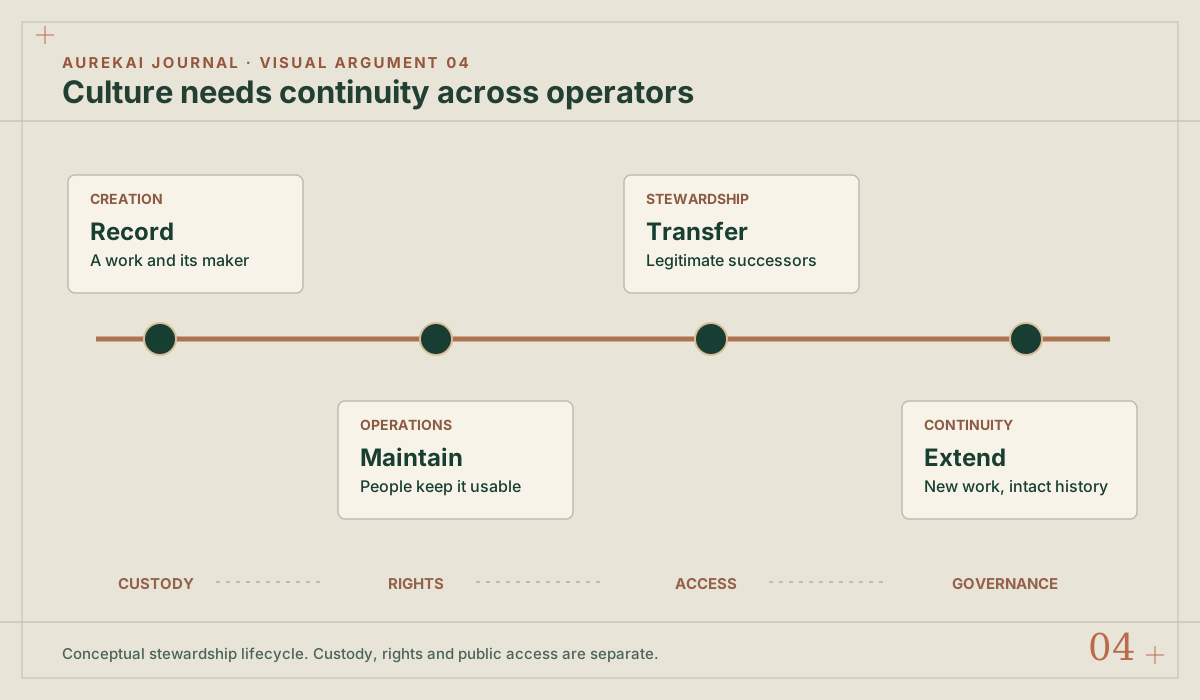
Imagine each independent publisher maintaining durable source identifiers, access decisions, original files, permitted transformations and recorded revisions. A community archive might expose open descriptions of a collection while restricting sensitive recordings. A researcher could cite the existence of material without receiving its full contents. A public story could link a snapshot of what was known at publication time, even after the working record changes.
Aurekai's idea of source-backed publications and living profiles could help make these relationships usable. It would still need partnerships with actual rights holders, archivists, libraries and communities. A technical index is not a mandate to ingest everything.
The important economic question is what happens to knowledge that no commercial discovery system has an incentive to preserve. If we only save what is already popular, future readers will inherit a narrower record of what people actually did.
Read next: The archive is not the owner and The local archive that never got uploaded.
Sources and further reading
References point to original material linked in the essay, not independently invented citations.
- UNESCO Charter on the Preservation of Digital Heritageunesco.org↩
- Internet Archive's Wayback Machine help guidearchivesupport.zendesk.com↩
- Nieman Lab reported in January 2026niemanlab.org↩
Related reading
More articles that explore this subject from another angle.
Repetition and popularity should not masquerade as independent historical evidence.
Follow this connection ↗The continuity problemThe internet has an inheritance problemPreservation also requires institutions that can survive their original caretakers.
Follow this connection ↗