“Where members believe that their contributions matter”
A block in Minecraft is a remarkably modest thing. Give people familiar materials, consistent rules and places to meet, and those blocks become villages, adventures, machines, classrooms, games and entire social worlds. People share what they built, teach each other, organize communities and sometimes make a living from it.
Minecraft did not have to specify every possible creation. Its community developed purposes that no individual feature list could have captured.
Most people who want to organize a festival, run a shop or publish a local history project don't begin by wanting to configure databases, webhooks and permission policies. They begin with something they want to make happen.
The ecosystem matters as much as the editor §
The Minecraft Partner Program[1] offers a marketplace for creators of maps, skins, adventures and textures. Applicants are expected to show original work. The relevant infrastructure isn't only building blocks: it's an audience, distribution, reputation, marketplace rules and recurring incentives to create.
Roblox's 2025 annual report[2] reported $1.5031 billion in creator earnings and more than 23,500 creators receiving cash through its program. Those are company-reported totals, not typical earnings; distribution and platform dependence are important caveats. Still, creative tools have supported consequential economic activity.
If we're looking for the internet's next general-purpose building environment, the question isn't whether its pages can be generated automatically. The question is whether people can build and share things that have a durable social and economic life.
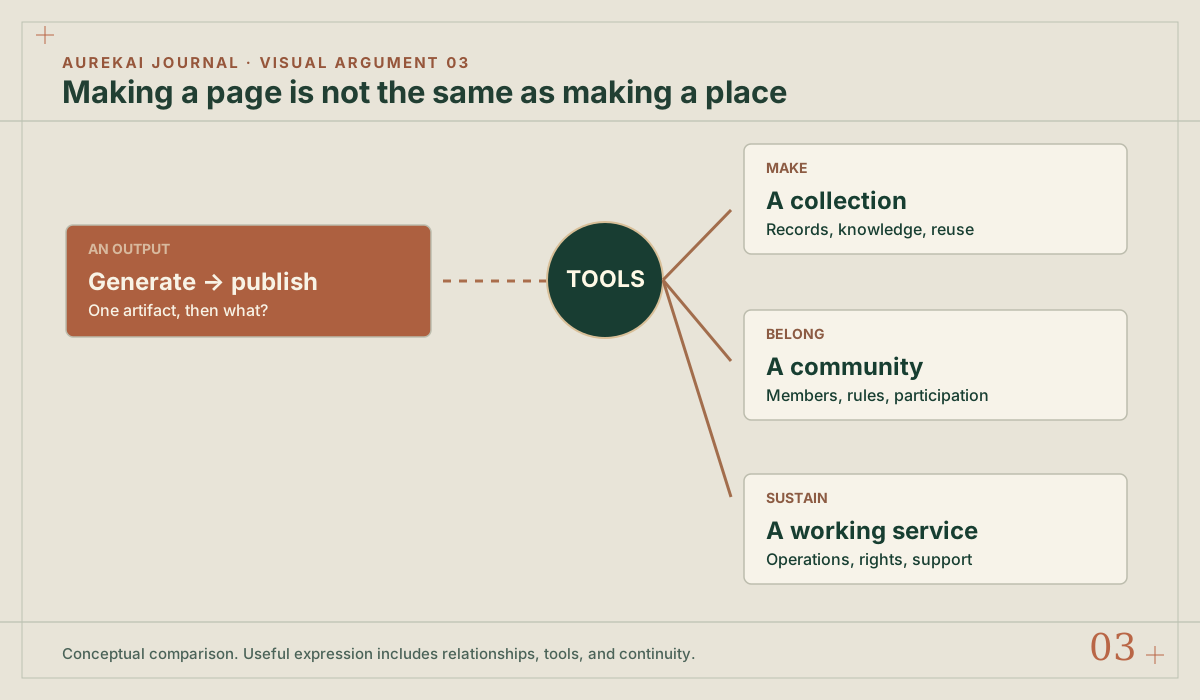
- What happensSimple creative building blocks
- What it missesSerious activity still needs infrastructure
- What could changeLet communities invent their own uses
What are the building blocks for ordinary life? §
Consider a weekend market. It has a place, date, participating vendors, products, performances, permits, accessibility requirements, ticketing, volunteers and photographs. A public guide explains what to expect. A vendor can display real inventory. A local journalist writes about it. An organizer plans capacity and pays suppliers.
Those are meaningful objects: person, business, event, publication, product, collection, project and offer. Their relationships are valuable because the participants don't have to recreate the event in every separate tool.
The visitors might see a map. Vendors might see a store. Organizers might use a schedule. A photographer might use a beautiful magazine. A spatial world would be wonderful if spatial exploration added something—not merely because the technology can render one.
Rules protect the freedom to create §
A community needs welcoming examples, education, moderation, discoverability and reasons to return. It also needs care around identity, copyright, payments, privacy and minors. An artist's shared image cannot be sold merely because it can be dragged into another page.
Aurekai could borrow the approachability of a creative platform without imposing a game aesthetic on people's actual businesses. Bonfÿre's underlying work could make the stable, difficult operations reusable.
The measure is not how many tools ship. It is how many kinds of useful things people can confidently build together.
Read next: Who gets to have sophisticated software?.
Sources and further reading
References point to original material linked in the essay, not independently invented citations.
- Minecraft Partner Programminecraft.net↩
- Roblox's 2025 annual reportsec.gov↩
Related reading
More articles that explore this subject from another angle.
Simple composable primitives can support uses their designers never specified.
Follow this connection ↗The design tensionWhy does every app want to be everything?Composable environments differ from one application trying to own every activity.
Follow this connection ↗