

“The medium is the message.”
A website was once the obvious place to explain who you were. Then it became the place to publish, sell, recruit, schedule, invoice and talk to customers. As those jobs became more demanding, we moved them into specialized applications. The website stayed at the center of the diagram, even as the important work moved elsewhere.
A small publisher might now have a domain, a newsletter provider, membership software, a social account, an event system and a spreadsheet. Readers see six disconnected experiences. Staff maintain six versions of relationships that belong to one institution.
That is the sense in which sites are dead. Not that personal domains, URLs or independent publishing should disappear. Quite the opposite: they are some of the best things the web gave us. The organizing unit behind a public address should be richer than a collection of documents.
Search is changing the route to a reader §
In Pew Research Center's 2025 observation of Google searches[1], people clicked a conventional result in 8% of visits with an AI summary, compared with 15% when no summary appeared. That observation does not prove AI caused the difference. It does show why publishers should question whether the familiar search-to-homepage journey can sustain their work alone.
A person may discover an article in a social feed, an AI answer, a friend's collection or a community discussion. The original author, sources, corrections and useful relationships ought to remain accessible wherever the discovery happens.
There are precedents for separating identity from one application view. AT Protocol[2] separates identity, data repositories and social app views; ActivityPub[3] supports communication among independent social services. Neither supplies a full business operating system, but they help establish that a social identity need not belong to a single website template.
- What happensA homepage represents a business
- What it missesIts work lives across disconnected systems
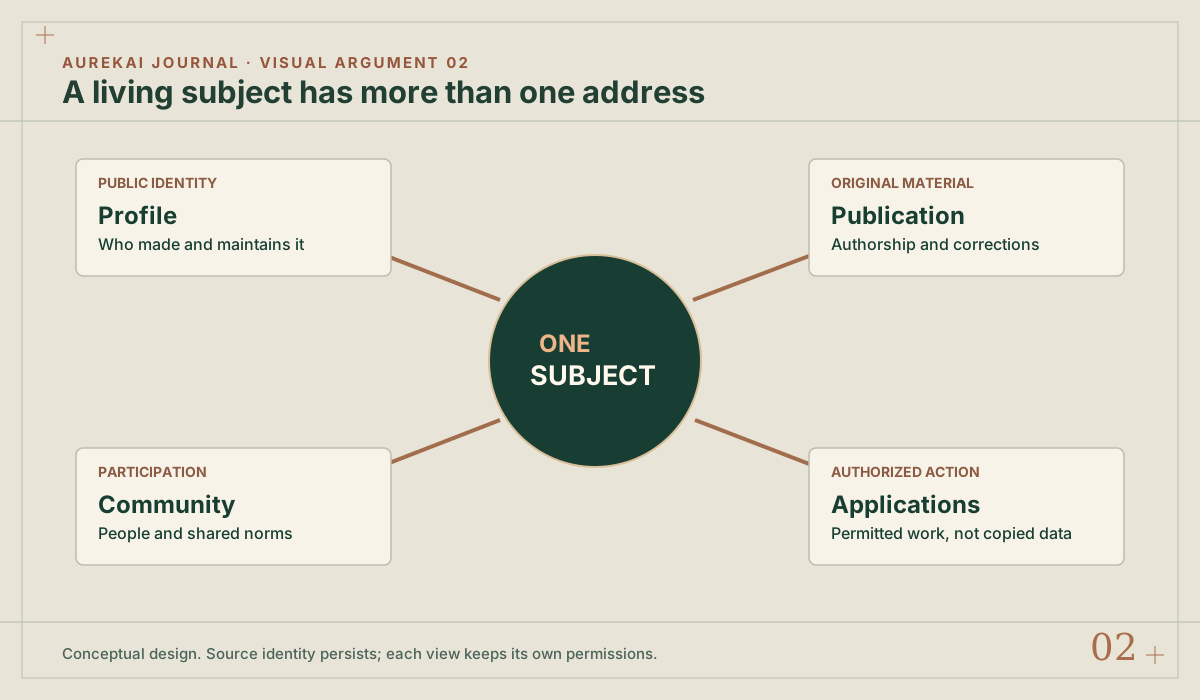
- What could changeOne subject, several legitimate views
An exhibition with more than one front door §
Imagine a neighborhood arts association. Its main site is a gorgeous magazine and calendar. An exhibition connects artists, work, research, tickets, venues, volunteers and sponsors. The artist has a distinct presence beyond the exhibition. The venue has its own calendar. A visitor saves a collection; another reads the research as an ordinary article; staff manage private capacity and orders.
One artwork should not become five unrelated records just because it appears in five places. Its history stays attributable, while audiences see permitted views appropriate to their context. An old ticket price is not a current offer. A public source is not a private planning note. A collaborator's identity is not the organization that employs them.
This is much harder than making a visually impressive homepage. It needs source identity, time, relationships, permissions, composition and accountable changes.
The web remains the public address §
Aurekai's long-term idea is to make sophisticated publishing, business and community capabilities available to many independent institutions without requiring each to invent the underlying infrastructure. Bonfÿre supplies shared native capabilities; the organizations keep their names, work, audiences and boundaries.
That is an ambition, not a claim that every described experience is already in production. We should judge it by whether somebody can enter through an article and move naturally to a collection, project or relevant application without rebuilding their account and losing the original context.
The website becomes a cover, a window or an entrance. The institution doesn't end at the door.
The address isn't the institution §
Consider a community bookstore. Its website lists events, but its reality includes readers, staff, shelves, suppliers, memberships, author visits, books held for customers and the neighborhood's memory of the place. If a social platform stops referring visitors, the business has not stopped existing. If its domain expires, many of its relationships still ought to survive. A web address can be a durable invitation without being the only container for those relationships.
This difference matters because the cost of composing a digital presence has historically meant choosing someone else's product boundaries. The newsletter owns subscribers; the shop system owns orders; the event service owns registrations; the social network owns discussion and discovery. Some boundaries protect legitimate responsibilities, but others force a small operator to maintain disconnected representations of one organization. The answer is not a super-app that swallows every institution. It is recognizable identities and permissioned capabilities that can participate in more than one view.
Connections need rules, not just links §
A reader following a writer should recognize their authorship across publications without assuming the reader owns the articles. A collector may display an object without claiming a right to sell it. An organization may show a volunteer's contribution without claiming to speak for that person. Links, provenance and permissions need to travel with what is represented.
The richer web imagined here would give people more entry points but fewer forced reinventions: stable public addresses, accessible pages, original source links, portable records where lawful, and ways to participate without an AI assistant mediating every click. It is a proposal for durable institutions, not a prediction that conventional websites will disappear.
Read next: The profile is bigger than the person and When reading becomes participating.
Sources and further reading
References point to original material linked in the essay, not independently invented citations.
- Pew Research Center's 2025 observation of Google searchespewresearch.org↩
- AT Protocolgithub.com↩
- ActivityPubw3.org↩
Related reading
More articles that explore this subject from another angle.
Recognizing an institution across services is a different problem from signing in.
Follow this connection ↗The human stakesWho keeps the internet alive?A connected presence matters only if the people and associations around it endure.
Follow this connection ↗Another essay leads hereNobody called the pizza shops slopAn explosion of new makers is not automatically a decline in culture. Tools can also make participation possible for people previously shut out.
Read the earlier argument ↗