“I am large, I contain multitudes.”
The familiar online profile is small: photograph, name, biography, links, feed. That's usually enough to identify an account. It's rarely enough to represent a person's work, much less a business, research organization, place or collection.
An artist has exhibitions, media rights and collaborators. A researcher has publications, datasets and questions. A historic building has stories, photographs, repairs, owners and a place in a neighborhood. None is naturally a sequence of social posts.
Identity should outlast one app §
The AT Protocol[1] usefully separates identity, repositories and application views. That does not mean a person's identity is the same kind of record as an organization's authority or a product's provenance. It means a public presence need not be defined entirely by one presentation.
Imagine a ceramic artist's profile. It opens as a carefully art-directed studio with projects and images. A visitor sees a current exhibition, materials, available work and an archive. A curator sees permitted collections. A buyer can purchase an available piece. The artist's own workspace contains private orders, contracts and financial records.
The same work should not be duplicated into unrelated public copies merely to appear in different experiences.
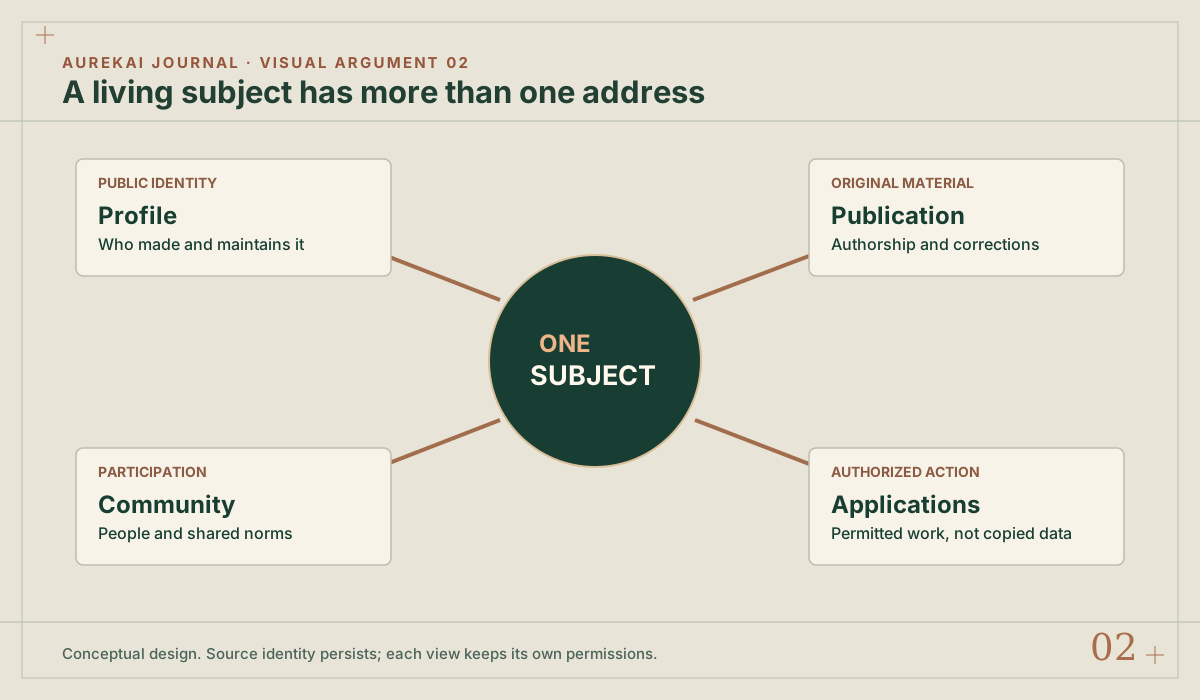
- What happensA profile lists a biography
- What it missesWork and relationships are elsewhere
- What could changeConnect authorship, projects, and community
A place can have a history §
Consider a neighborhood library. Its presence includes people, programs, collections, rooms, historical events and perhaps community research. An individual event is also part of the presenter's profile. A source document can belong to a research collection without becoming the property of whoever saved it.
Time makes these relationships harder. An event ends. A project gets revised. A price expires. A source is corrected. Someone must be able to distinguish current activities from historical records.
Permission matters as much as presentation. Being named in a publication is not consent to impersonation or control. An organization's administrators must be verified. A public record may warrant privacy and correction safeguards. Attribution must not silently become ownership.
Profiles become more useful when they connect §
Aurekai has discussed expanding existing public identities across thousands of people and organizations. The weak approach is thousands of shallow pages. The stronger approach is connecting permitted publications, creators, projects, collections, institutions and communities that already exist.
Those subjects can have strikingly different presentations: a magazine, store, event world, research archive or directory. The shared foundation should preserve the particular relationships beneath each design, not force every one into a generic feed.
And an author who belongs to an organization should be modeled through that actual organization or account, not an invented universal category that erases ownership.
The profile is no longer a box about the person. It is an entrance to the work and relationships that make the person, place or institution worth discovering.
Read next: Sites are dead. Long live the web..
Sources and further reading
References point to original material linked in the essay, not independently invented citations.
- AT Protocolgithub.com↩
Related reading
More articles that explore this subject from another angle.
Different representations need an honest account of when they name the same subject.
Follow this connection ↗An institutional exampleA publisher deserves a home, not another feed entryPublishing illustrates how one identity can support many kinds of participation.
Follow this connection ↗Another essay leads hereThe internet has an inheritance problemWhat happens to forums, publications, recordings and communities when the people running them retire, die or disappear?
Read the earlier argument ↗