“Not every new storefront has to invent the street.”
Imagine a town where opening a small restaurant once required hiring an architect, a software company and a distribution consultant. When those costs fall, more restaurants open. Some are forgettable. Some are magnificent. Some become neighborhood gathering places. Their value isn't exhausted by the novelty of their menus.
When small pizza shops proliferated, nobody needed to regard every new shop as an artistic triumph for the phenomenon to matter. The shops served people, employed workers, created relationships and gave local owners a chance to participate in an economy.
The analogy matters when we talk about today's avalanche of AI-generated websites, images, newsletters, apps and videos. A lot of the material really is low-effort, derivative or misleading. Calling it all slop, however, obscures a second possibility: the cost of producing an artifact may be falling for people who never had the resources to produce one before.
Production quality is only part of the question §
A school club that can finally build an event site may produce something visually ordinary. A retired radio host can make decades of recordings findable. A neighborhood seller can give a small catalogue the kind of presentation once reserved for a chain store. These are not necessarily feats of original design. They can still create real value for identifiable communities.
The useful distinction is between mass-producing artifacts to consume attention and giving people the power to express, organize and sustain something they care about.
A generated page designed solely to manipulate search rankings is not the same as a modest site that helps a local club organize. Volume and intent don't settle quality, but the social purpose of an artifact cannot be ignored either.
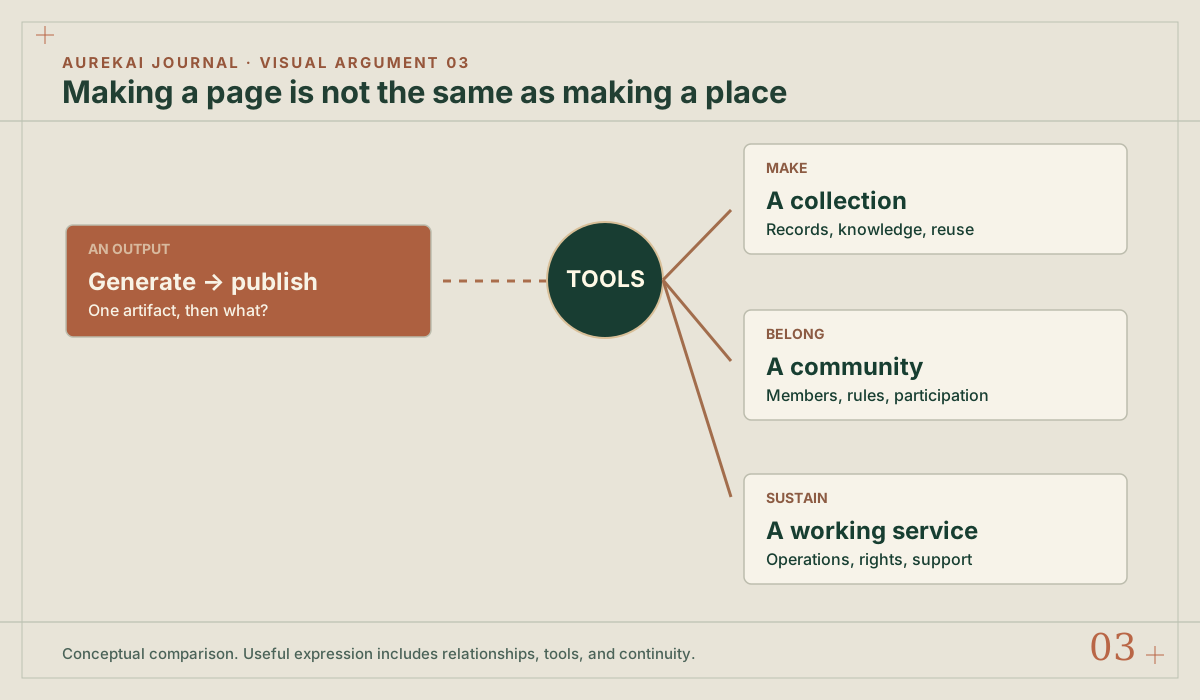
- What happensMore people can publish
- What it missesMost tools stop at generating a page
- What could changeSupport relationships and real services
More creators don't guarantee a better internet §
There is no reason to romanticize every output. Easy generation also makes it cheaper to flood platforms, impersonate people, hide plagiarism and wear down attention. The people operating legitimate publications bear the consequences.
The answer cannot be simply to bring back a world where only established organizations have the resources to produce sophisticated work. It should include source attribution, discoverability, original work, consent, ownership, correction, useful communities and ways to distinguish authentic activity from fabricated claims.
In the 2003 Charter on the Preservation of Digital Heritage[1], UNESCO recognized that digitally created expression is part of cultural heritage, and that it risks being lost through obsolescence and neglect. Digital cultural value is not confined to the most professional-looking publications.
Make the tools worth using after the first page §
If making a site is as simple as ordering a template, what happens afterward? Can a person welcome members, collect meaningful contributions, run a shop, plan an event, preserve their work and earn a fair return? Can others find and participate in the resulting environment?
This is where a Minecraft-like creative ecosystem is more illuminating than a page generator. The tools enable culture, commerce and relationships; they don't supply those outcomes automatically.
Aurekai's opportunity is to make those connected capabilities reachable without requiring every participant to master a complex software stack. The measure is not the number of things made, nor whether every one looks exquisite. It's whether more people can do worthwhile things together.
What a generated storefront leaves out §
The neighborhood pizza analogy is deliberately imperfect. Restaurants have physical costs, health regulations, labor obligations, real customer relationships and observable consequences when they disappoint. Digital content can be produced in enormous volume, sometimes deceptively and at almost no marginal distribution cost. Complaints about scams, fabricated testimony, attention capture and unconsented imitation deserve serious treatment.
But those harms do not explain everything people call slop. A newcomer using shared templates to run a useful club or specialist publication is not a cultural failure because the page looks ordinary. A local shop needn't invent a new kind of commerce to contribute to its neighborhood. We should distinguish empty artifacts designed to impersonate value from modest creations that actually serve someone.
The gap between making and belonging §
Many AI tools lead to a finished image, text block, app or static website. They seldom provide the capabilities that let someone build an enduring relationship: community governance, trusted attribution, payments where appropriate, event organization, permissions, shared collections, discussion or ordinary maintenance. The creator is given an output, then told to assemble a small software company to make it useful.
Someone might want to operate a music archive, help neighbors share tools, teach a language, coordinate a festival or run a repair cooperative. These are expressive acts but not primarily art objects. Their quality depends on relationships and continuity, not simply how polished their pages look.
Perhaps some of the internet's repetitive surface is a symptom of repetitive affordances. Give millions of people the same prompt box and publishing template, and many results will resemble one another. Give them comprehensible building materials that can form communities and institutions, and variety may emerge in the lives of the things they build.
Related: We didn't run out of ideas and Minecraft built a world.
Sources and further reading
References point to original material linked in the essay, not independently invented citations.
Related source context: doi.org. Source links do not imply endorsement.
Related reading
More articles that explore this subject from another angle.
Cheaper production does not make the relationships and obligations of a business free.
Follow this connection ↗The possible environmentSites are dead. Long live the web.Expressive tools become richer when they can make lasting, connected places.
Follow this connection ↗