

“This index card, this slender rubber band”
A great deal of cultural history isn't waiting behind a search result. It is in a filing cabinet, a cassette box, a community bulletin, a hard drive from a retired producer, a club's old web server or a stack of unlabeled photographs.
From the perspective of a modern search engine, that material may barely exist. From the perspective of a community, it may explain who they are.
This is why discussions of the dead internet often miss an important counterpart: some of the most valuable parts of the internet were never properly digitized in the first place.
A radio station knows what the archive doesn't §
A local radio station has decades of interviews, live performances, public announcements and community conversations. Some were recorded on obsolete media. Some have incomplete titles, missing dates and complicated rights. A recording can mention ten people whose identities were never entered into any database.
The Library of Congress public broadcasting web archive[1] collects station sites and affiliated organizations, complementing the American Archive of Public Broadcasting. Its stated scope includes programming, history and potentially recordings not held elsewhere in the companion collection.
The existence of a national preservation program does not mean every independent recording is preserved or publicly accessible. The gap between a collection's existence and its discoverability is one of the problems worth solving.
- What happensA community holds recordings and records
- What it missesThe search index cannot see them
- What could changePreserve context with lawful discovery
Digitization is not a one-button transformation §
A scan captures an image. It doesn't settle whether a name was recorded correctly. Transcription can make speech searchable, but it can mishear an accent, omit context or expose private information. Translation can expand access, yet a translated account is not a substitute for the original.
Metadata is a form of care. The date of a recording, the person who supplied it, the rights governing reuse and the uncertainty surrounding identification are all part of the material.
The Library of Congress's Indigenous government web-archiving account[2] gives an especially concrete reason to preserve old versions: online records can represent a historical state of an institution that later changes or disappears. Preservation is not just backing up the last published page.
A public archive can become a living place §
An independent local archive could publish attributed exhibits, searchable collections, recordings and community histories. A listener could contribute a correction, a family member could request appropriate privacy review, a teacher could assemble a permitted reading collection and a new producer could locate a relevant old interview.
The public experience could be beautifully designed, while the underlying records retain provenance, access limits and multiple revisions. It should be possible to acknowledge that an identity is uncertain rather than manufacture an exact match.
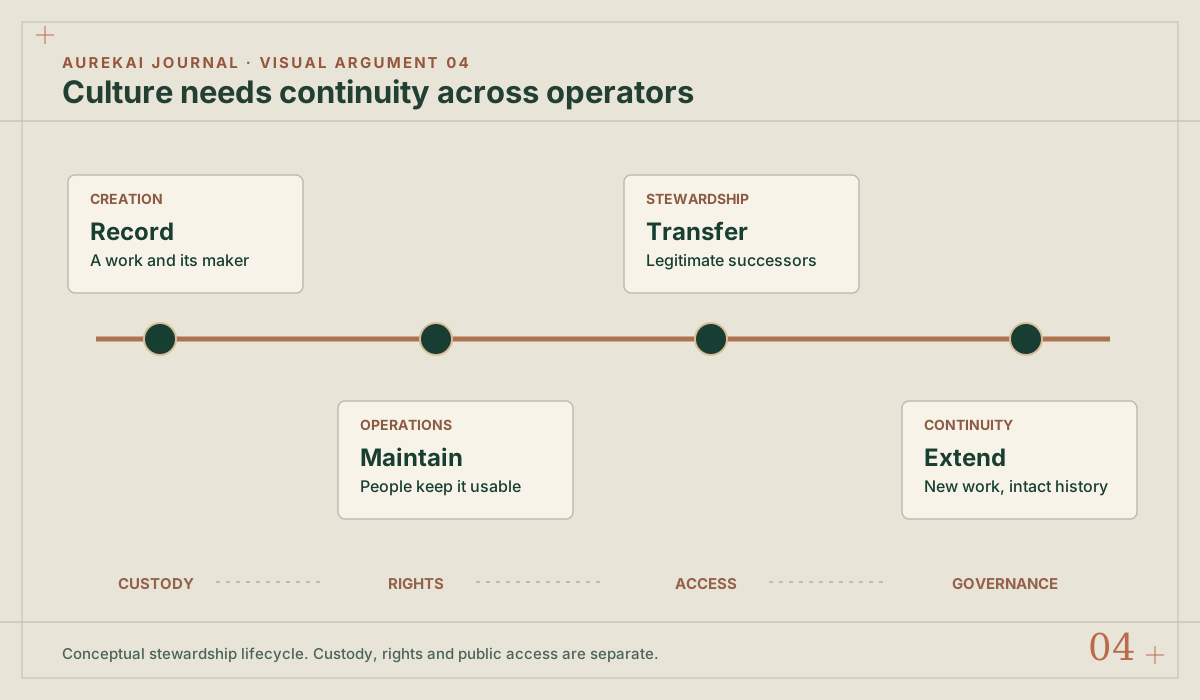
Aurekai's proposed source and publication systems are relevant to this type of work. But the technology should serve the original operator and community: a digitized archive must not be a transfer of ownership to whoever paid for OCR or transcription.
The next cultural breakthrough might not be generated. It might already be sitting in a box, waiting for somebody to make it findable without stripping away its history.
Read next: A library of Alexandria selected by demand.
Sources and further reading
References point to original material linked in the essay, not independently invented citations.
Related reading
More articles that explore this subject from another angle.
An audio collection gains value through intelligible preservation and continuation.
Follow this connection ↗Civic recordsA city council agenda should lead somewherePublic records become useful when context and original sources remain accessible.
Follow this connection ↗