“A fragment can travel farther than the work that gave it meaning.”
A long interview becomes a thirty-second video. The clip reaches far more people than the original recording. It may introduce a person, book, community or idea to an audience that would never have found the full conversation.
The clipper has performed work: selecting a moment, editing it, writing a title, choosing a format and distributing it. The original producer has also performed work: arranging the conversation, building trust, recording it, maintaining an audience and bearing responsibility for the broader context.
The two contributions should not be conflated.
Distribution is an editorial activity §
The Reuters Institute's 2026 Digital News Report[1] identifies the growing role of video and social platforms in people's encounters with news. When material moves through those channels, a compelling excerpt may be the first or only part someone sees.
Selection can make a complicated discussion accessible. It can also reverse the meaning of a speaker's statement by omitting context. A useful clipping economy must have ways to preserve links to originals, dates, permissions and corrections.
Consider an interview with a small-business owner about why a local venue closed. One sentence about rent might travel widely; the full interview also discusses staff, construction, customer habits and the operator's experience. The clip is valuable, but a reader should have a route back to the larger record before treating the excerpt as a complete explanation.
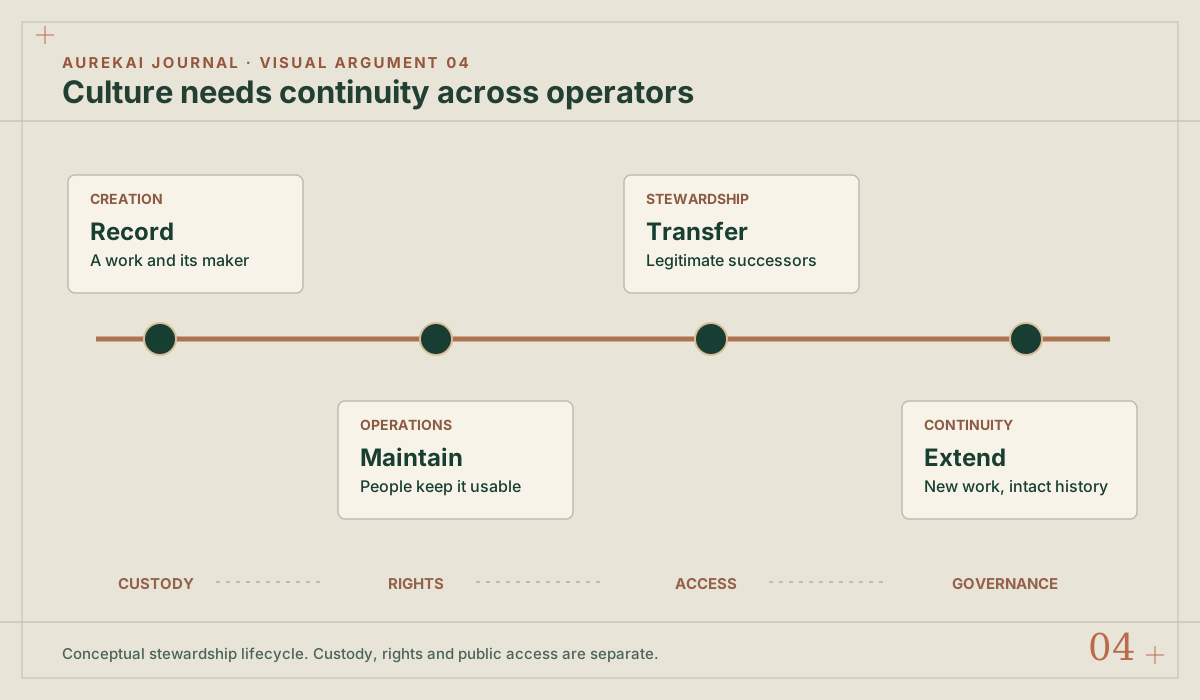
- What happensAn excerpt travels widely
- What it missesOriginal meaning and credits fall away
- What could changeConnect the clip to its people and sources
The creator economy is not one job §
A podcast host, local radio producer, transcription editor, independent archivist, translator, photographer and clipper might all contribute to a single publication. Some work is commissioned, some licensed, some volunteered and some governed by collective agreements.
We should not pretend one default creator profile or one generic revenue-share scheme resolves these relationships. A person can be a contributor to one organization, the owner of another and a member of a collective elsewhere. The permissions are attached to the work and relationships, not merely to a username.
The Creative Commons license guide[2] is a practical reminder that permission to adapt, distribute and commercially reuse material varies. Work that lacks an explicit open license should not be presumed free to repurpose.
A better continuation than another upload §
Imagine a verified recording with chapters, speakers, contextual notes and source links. A permitted clip has its own public page and points back to the recording; contributors are credited according to their roles. A translation identifies the language of the original. The publisher can assemble a series from the same source without losing earlier rights decisions.
Those are the kinds of relationships Aurekai's publication, profile and source systems might eventually support. They are not a reason to copy every creator's work into a proprietary database.
The ambition is a richer media ecosystem in which editors and clippers can make useful contributions without severing the thread connecting an excerpt to its people, meaning and ownership.
Related: The archive is not the owner.
Sources and further reading
References point to original material linked in the essay, not independently invented citations.
- Reuters Institute's 2026 Digital News Reportreutersinstitute.politics.ox.ac.uk↩
- Creative Commons license guidecreativecommons.org↩
Related reading
More articles that explore this subject from another angle.
Editing improves discovery without replacing a source's context or consent.
Follow this connection ↗Independent evidenceThree headlines repeating a claim can still be one observationA widely distributed fragment can hide how little original reporting lies behind it.
Follow this connection ↗Another essay leads hereThe song is not the file that plays itCompositions, recordings, tracks, releases, performers and rights need a relational model, not one media row.
Read the earlier argument ↗