“the miracle of a few written signs being able to contain immortal imagery”
A person knows a great deal about something nobody has thought to turn into an application. It might be neighborhood history, a specialist trade, a collecting community, a style of music or the little-known logistics of a local event.
The problem isn't always that nobody wants the material. Often the material is difficult to publish, connect, finance and sustain. A researcher can write an article but struggles to make the archive usable. A collector can post images but not build a proper catalogue. A community organizer can create a group chat but not an accessible calendar, membership system and public record.
We frequently interpret the absence of those experiences as an absence of good ideas. It may instead be a shortage of accessible means of expression.
The tool changes what can be imagined §
A spreadsheet makes it possible to model a business without asking for a custom accounting product. Minecraft lets people design social spaces by manipulating understandable objects. A social network gave groups, identity, events and photographs to people who would never have commissioned a website.
In each case the material was not particularly mysterious. The new thing was the ability to combine familiar components without needing the expertise that previously mediated their creation.
The Minecraft Partner Program[1] now supports independent creators making marketplace experiences. It is one example of creative capability becoming an ecosystem with publication and distribution, not only a pile of tools.
- What happensSpecialist knowledge stays invisible
- What it missesPublishing tools do not support the work
- What could changeMake those interests operable together
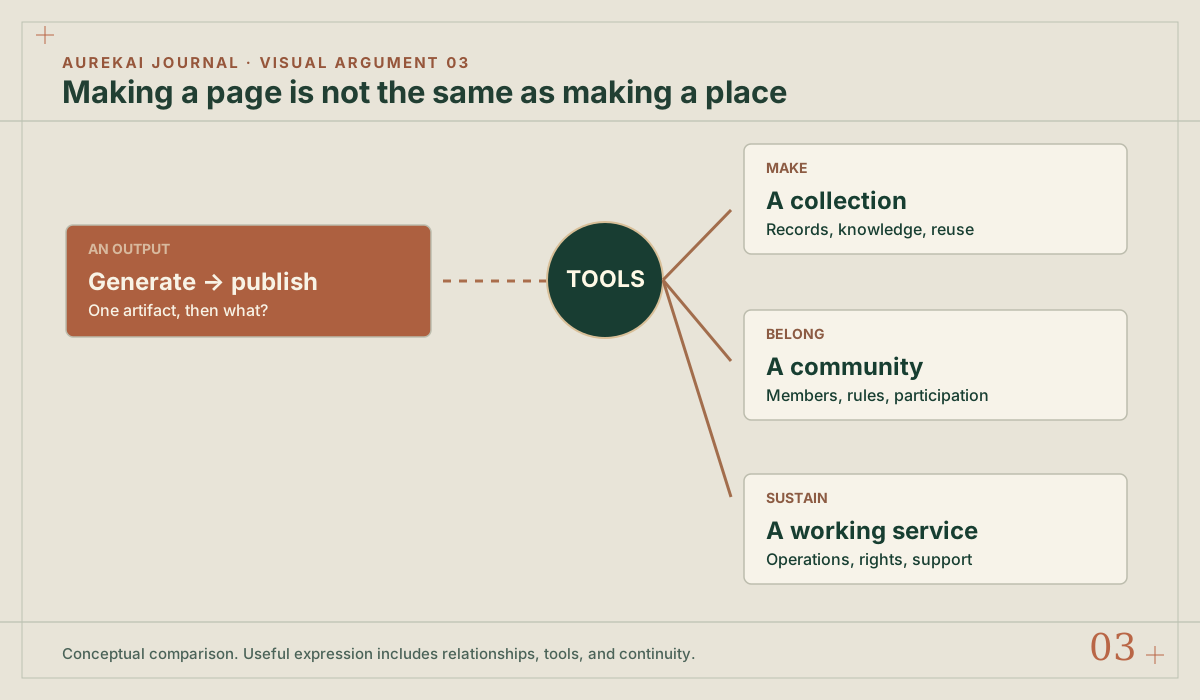
Making something is not yet participating §
A newsletter is easy to start compared with building a publishing company. Still, a newsletter with no sustainable audience, payment model, original material or community can fade quickly. A generated storefront can accept a product description but cannot manufacture reliable stock, negotiate with a supplier or build customer trust.
An accessible internet should make those next steps less isolated. The creator of an archive should be able to invite a collaborator, credit contributors, issue a corrected edition and share a permitted collection. A small organization should be able to establish members, schedule activities and publish what happened without bolting together half a dozen unreliable systems.
That doesn't mean every website should be a social network, commerce platform and office suite. It means the underlying capabilities should be available when the work calls for them.
People should get to decide what their work becomes §
The greatest risk in a platform built from reusable capabilities is that all the resulting experiences come to look and behave alike. A musician's archive and a city-planning record shouldn't be forced into one generic feed. The common infrastructure exists to make difference affordable, not to eliminate it.
Aurekai's living-profile concept is one response: each person, institution, object or community can have a distinctive public expression backed by reusable operations and source identity. That remains a product ambition to prove with real people and real use, not a result established by publishing this essay.
The internet does not need infinitely many identical apps. It needs more ways for the enormous range of human interests to become durable, useful and shared.
Next: Sites are dead. Long live the web. and Who gets to have sophisticated software?.
Sources and further reading
References point to original material linked in the essay, not independently invented citations.
- Minecraft Partner Programminecraft.net↩
Related reading
More articles that explore this subject from another angle.
The missing ingredient may be access to existing knowledge and capacity.
Follow this connection ↗Creators in practiceA creator can have millions of views and still need a back officeA creator needs distribution, administration and control, not just a better generative model.
Follow this connection ↗