“When every product builds the same rooms, the doors between them matter more than the rooms.”
Open enough applications and their menus begin to look alike. Writing software acquires tasks and databases. Social networks acquire shopping and payments. A storefront adds memberships and community tools. A game becomes a marketplace for the things its players create.
There is a joke about evolution repeatedly producing crabs. Software has its own recurring body plan: identities, relationships, content, search, coordination, transactions and now AI assistance. The metaphor is useful so long as we don't mistake it for a scientific law.
Two different forces create this resemblance. People really do need connected capabilities. Companies also benefit when customers never have to leave.
The useful reason for convergence §
Imagine a historian collecting photographs for an exhibition. She needs permission from contributors, a catalogue, a publication, scheduling, discussion and perhaps ticket sales. The work really is connected. Forcing her through six unrelated applications is a poor expression of it.
The Notion template marketplace[1] shows how an adaptable set of pages and databases becomes useful in ways the original toolmaker did not individually prescribe. Planners, editorial systems, learning tools and small-business workflows emerge from community-made patterns.
That is the compelling part of convergence: people can assemble capabilities that make sense for their own work.
- What happensEach app wants the whole user
- What it missesInstitutions cannot move their work
- What could changeCompose tools while retaining boundaries
The expensive reason for convergence §
If every product reproduces identity, messaging, permissions, file storage, AI, payments and reporting, people end up with contradictory copies. One organization's public price updates, but another service continues displaying the old price. A member's access is revoked in one system but survives in a linked workspace. Someone fixes a factual mistake and its earlier copies keep circulating.
A super-app can reduce the number of logins, but it can also move the entire problem inside one vendor's walls. Customers may have fewer choices about suppliers, data portability and presentation.
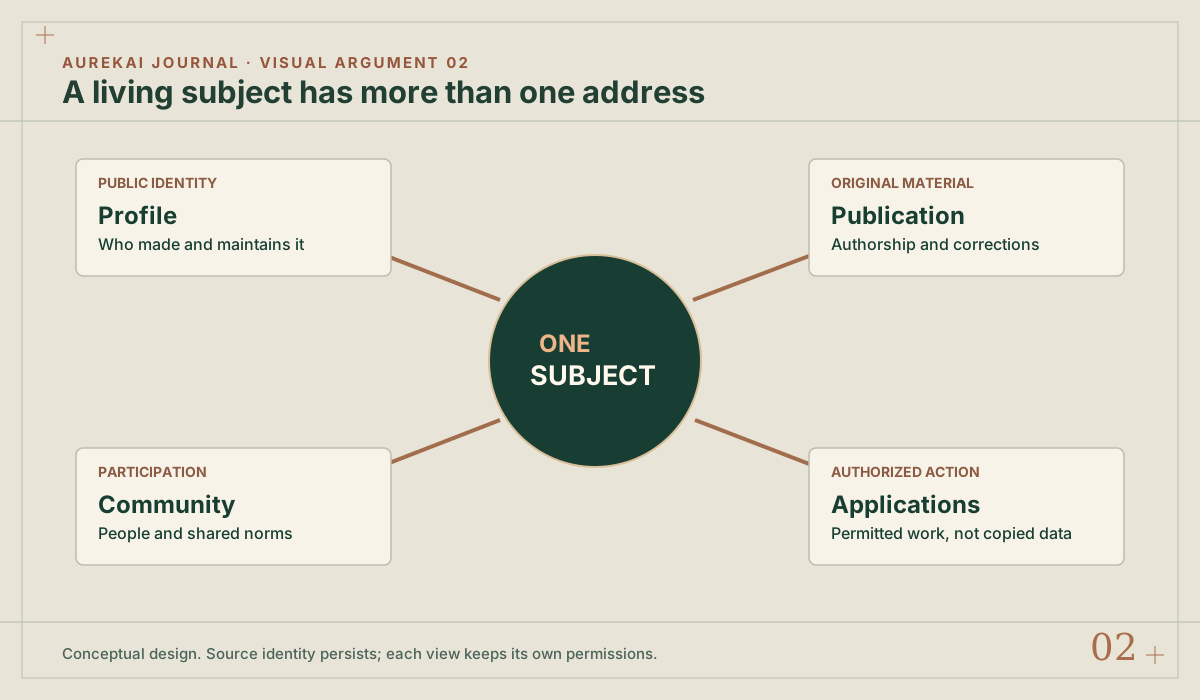
Instead of building everything into each app, we can ask which capabilities deserve to be shared. A product record can feed a store, a room plan and a procurement discussion; each has different permission to act. The record shouldn't be copied into three independent authorities.
Different organizations still need different experiences §
A bakery needs production planning, ingredient stock and orders. A public archive needs attributed sources, collections and corrections. A music collective needs events, recordings, rights and merchandise.
No one generic dashboard will do justice to all three. Their shared operating needs are still considerable: identity, documents, members, publishing, communication, payments and constrained work.
Aurekai's aim is to reuse those foundations while letting each public experience take its own shape. ActivityPub[2] demonstrates that systems can exchange social activity through a standard without becoming one company's software. It doesn't magically solve commerce or accounting, and that limitation matters.
The outcome we should want is not an app that contains everything, but an ecosystem in which small, comprehensible applications can participate in something larger.
Read next: The spreadsheet that became a business.
Sources and further reading
References point to original material linked in the essay, not independently invented citations.
- Notion template marketplacenotion.com↩
- ActivityPubw3.org↩
Related reading
More articles that explore this subject from another angle.
Different kinds of connection need different identity and authority contracts.
Follow this connection ↗The application substrateWhat we learned from Frappe without copying its whole runtimeA shared application grammar can provide reuse without forcing a universal interface.
Follow this connection ↗Another essay leads hereMinecraft built a world. What about everything else?What accessible creative primitives and communities can teach us about making serious software available to everyone.
Read the earlier argument ↗Another essay leads hereThree shops shouldn't look like the same websiteWhat a shared platform should change for an agency managing several independent customers.
Read the earlier argument ↗