

“more Americans are bowling today than ever before, but bowling in organized leagues has plummeted”
We tend to describe the internet through platforms and their audiences: search engines, social networks, creators and consumers. The people doing the daily work of keeping smaller digital places useful disappear into those categories.
Think of a longtime forum moderator, a local journalist, a university librarian, a small radio station's archivist, an independent newsletter editor, a museum volunteer or the person who manages a professional community's recordings. They collect material, make editorial decisions, negotiate access, explain context, maintain relationships and deal with problems.
They operate institutions, even when those institutions have only a handful of people and a modest website.
Distribution is moving away from the original institution §
The Reuters Institute's 2026 Digital News Report[1] finds that social and video platforms have become more common news sources globally than traditional channels. The report says 54% of surveyed people use social media and video networks for news. For an independent publisher, that shift changes how an audience encounters work and how difficult it is to retain a direct relationship.
The news story may be read in a feed; a clip may circulate without the full interview; a historical photograph may travel without the archive that explained it. A person can encounter the content without knowing who made it, how it was maintained or where to return.
This is not just a marketing problem. It makes the work of operating the original institution less visible and, sometimes, less economically sustainable.
- What happensActivity and audiences grow
- What it missesSmall social institutions lose operators
- What could changeSupport the people who maintain continuity
Operators provide things automation cannot assume §
An editor knows why an interview matters to a town. A forum moderator understands the history of an argument. A local radio producer remembers a guest whose name was misspelled on the original tape. A librarian can help resolve a dispute about authorship and permissions.
AI transcription, tagging, translation and search can make these assets more accessible. They do not, by themselves, establish ownership, accuracy, informed consent or the value of a relationship.
The Library of Congress web archiving program[2] explicitly preserves sites because they document organizations, public reactions and culture that can vanish when URLs change. Many such sources survive only because someone cared enough to maintain them.
An internet economy for operators §
Aurekai's larger idea could give this work a more visible place. The operator of a forum might have a publication and community linked to its history. A local broadcaster might create a searchable archive, licensed excerpts, contributions and new member programs. A research collector could maintain source trails, public reading rooms and collaborations.
The key is not to convert every operator into an influencer. It is to make the work of organizing, preserving and connecting material economically and socially viable, including for people who are not chasing scale.
Shared infrastructure should reduce the administrative cost of operating these spaces while preserving their own names, ownership and rules. The platform can support distribution without claiming that the operator's work belongs to the platform.
The next internet will be shaped by whoever can keep a useful institution alive after the first viral post is forgotten.
Bowling without leagues §
Robert Putnam's bowling observation is a useful introduction to this problem. People can continue doing an activity even as the associations that give it social texture weaken. Likewise, an internet can publish more posts, clips and newsletters while losing stable groups, editors, moderators, shared norms, physical archives and local institutions that make participation meaningful.
That does not mean the old institutions were always better. Forums could be exclusionary. Local papers could overlook whole communities. Gatekeepers sometimes abused their power. The goal is not nostalgia. It is to preserve what was valuable, make it possible to challenge what wasn't, and reduce the costs of forming better alternatives.
An operator is more than an account §
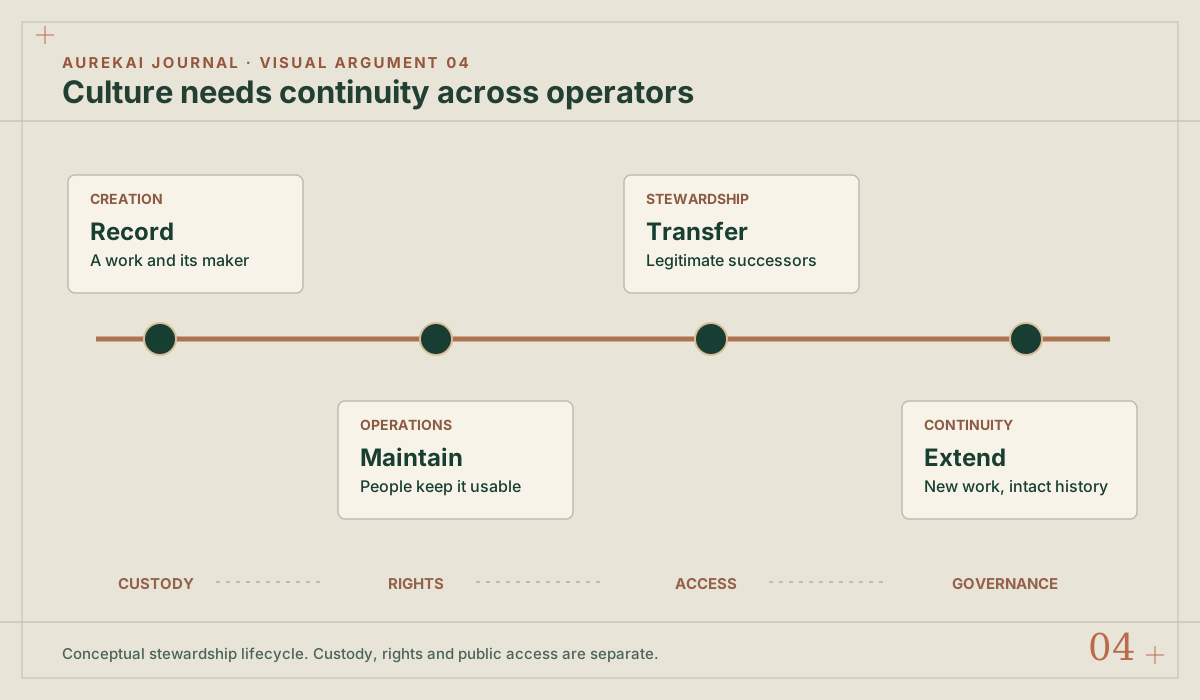
A local radio producer may possess decades of recordings. A collector may understand which recordings matter. A family may hold rights in a deceased broadcaster's work. A library may preserve copies under restricted access. A researcher may add context, while a clipper introduces a small excerpt to a new audience. These roles create different kinds of value and carry different kinds of authority.
If one platform collapses, the value should not necessarily collapse with it. Durable source records, transparent attribution, documented permissions, successor arrangements and independent distribution routes can help. Where labor or licensing relationships are unequal, unions, guilds, cooperatives and collecting societies may provide forms of collective power appropriate to their participants.
Preservation is not a license to exploit everything that survives. And ownership is not an excuse to erase public memory. A mature system must accommodate both the continuity of culture and the legitimate interests of the people whose work constitutes it.
Related: The local archive that never got uploaded and The profile is bigger than the person.
Sources and further reading
References point to original material linked in the essay, not independently invented citations.
- Reuters Institute's 2026 Digital News Reportreutersinstitute.politics.ox.ac.uk↩
- Library of Congress web archiving programloc.gov↩
Related reading
More articles that explore this subject from another angle.
Open publication protocols can preserve distribution beyond any one feed.
Follow this connection ↗A publisher's homeA publisher deserves a home, not another feed entryIndependent editorial institutions need an address, history and tools of their own.
Follow this connection ↗Another essay leads hereSites are dead. Long live the web.A website can be the front door to a living publication, business or community without containing the whole institution.
Read the earlier argument ↗