“The cheaper the artifact, the more valuable the judgment around it.”
There is a plausible future in which someone can make a small application more cheaply than purchasing a specialist subscription. A teacher makes a learning tool. A shop owner describes an inventory process and gets a prototype. A publisher devises a new way to explore an archive.
This should be exciting. But it creates a question we often skip: what happens after the application works for the first afternoon?
Not quite Moore's law §
We can use the phrase Moore's law for software as shorthand for falling production cost. It isn't an established exponential law. We don't have one universal measure of software complexity, value or correctness.
In METR's early-2025 controlled experiment[1], developers experienced with their repositories completed tasks more slowly when allowed to use contemporary AI tools. METR's 2026 update[2] suggested that later models might be faster but emphasized selection effects and uncertain measurement. Those experiments cannot settle what AI will mean for every developer or task.
Meanwhile the 2025 Stack Overflow survey[3] found significant AI use and substantial distrust of output accuracy. Creating more code and operating more reliable software are different achievements.
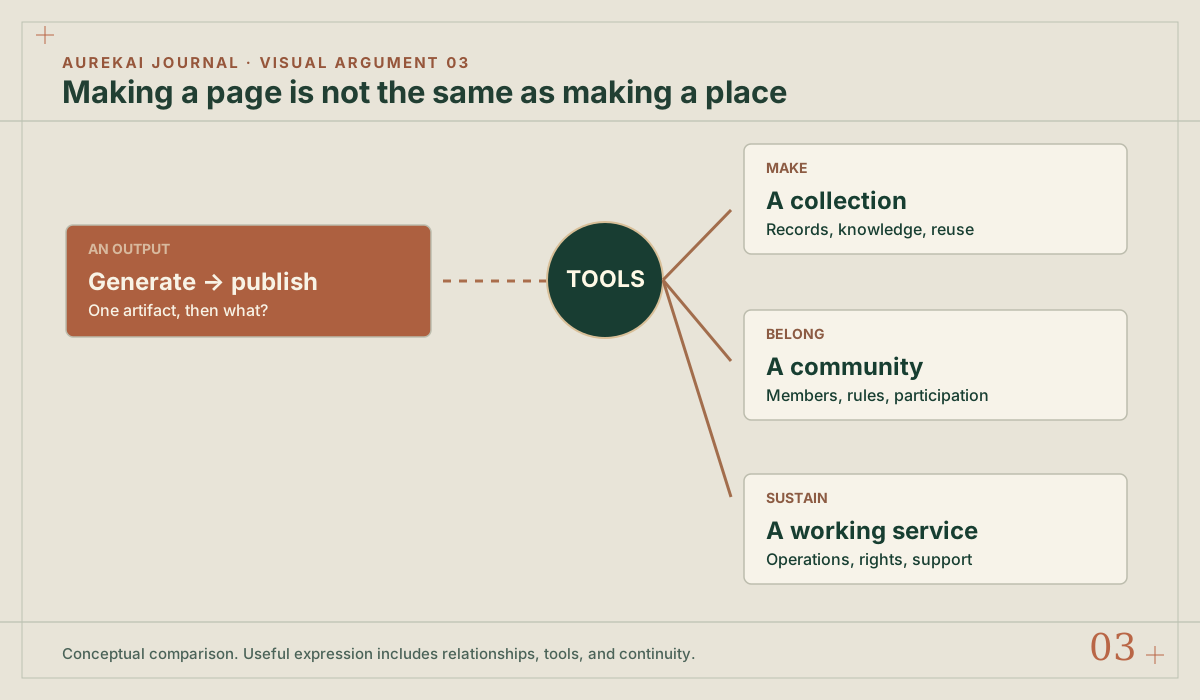
- What happensAn app arrives quickly
- What it missesOperations, rights, and maintenance remain
- What could changeGive creation an accountable lifecycle
A thousand custom tools still need maintenance §
Imagine a neighborhood group generating an event-registration application. The form and calendar are easy. Then somebody asks: can one member see another's address? Who may refund a payment? What happens when a volunteer leaves? Where do corrections go? What if an external provider changes its price? Which copy holds the official record?
These questions do not disappear when generation becomes cheaper. They become more common as software proliferates.
Abundance may therefore make coordination, discoverability and trust more valuable. People need to know whether an application is maintained, accessible, interoperable, properly authorized and suitable for their circumstances.
The model should not be the toll booth §
Aurekai's proposed approach is to let experiences use shared native operating capabilities where possible. Model assistance may help create, search, translate or explain, but a person should be able to read an ordinary public page without paying for an inference every time.
A generated interface must not acquire permission merely because it can ask for it. Reading an account record, proposing a change, publishing something and moving money are different operations, subject to separate checks.
The more software people produce, the more valuable it becomes to preserve durable identities, source history, reviewable actions and credible places to discover useful work.
The prize isn't an internet flooded with disposable apps. It's an internet where ordinary people can build things that remain useful.
Read next: Who gets to have sophisticated software?.
Sources and further reading
References point to original material linked in the essay, not independently invented citations.
- METR's early-2025 controlled experimentmetr.org↩
- METR's 2026 updatemetr.org↩
- 2025 Stack Overflow surveysurvey.stackoverflow.co↩
Related reading
More articles that explore this subject from another angle.
Generating an application does not prove it can be operated safely.
Follow this connection ↗The actual finish lineThe agent finished coding. The project isn't finished.An agent completing code is only one stage of delivery and support.
Follow this connection ↗